I Saved Something From the Net and It Automatically Uploaded the Documents
You can salvage a file to a folder on your hard disk drive, a network location, the cloud, a DVD, the desktop, or a flash drive. While you must identify the destination, if information technology is unlike than the default folder, the saving process is the same regardless of what destination you choose. By default, Part programs save files in the default working folder.
Additionally you can save a file in a different file format, such as RTF, CSV, or PDF.
Saving a file to OneDrive or SharePoint allows you to admission it on any device and enables features such as AutoSave and Version History, which can help prevent data loss if your file closes unexpectedly.
To relieve your file:
-
Printing CTRL+S or select File >Save.
Tip:You tin too select Salvage
 on the Quick Admission Toolbar.
 -
You lot must enter a name for the file if you are saving it for the first time.
Tip:Save your file to a cloud location, such as OneDrive or SharePoint, to be able to admission it anywhere, collaborate with others in real-time, and access Version History.
Past default, if you're signed in, files are saved to your OneDrive. If yous want to relieve the current file somewhere else, click the Location drop-downwards to see additional recently-used locations. If the location you want isn't there, y'all tin can open the total Salvage Every bit window by selecting More save options.
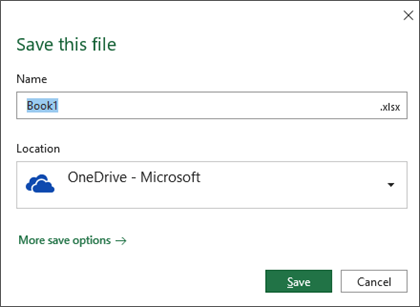
Tip:If you save your file to OneDrive or SharePoint, AutoSave will be enabled past default, so you don't have to remember to save as you go.
If you'd like to change the default location for these saves to ane of your other recently-used folders, select the Location drop-downward, right-click the folder location y'all want to gear up as the default and select Set equally Default Location.
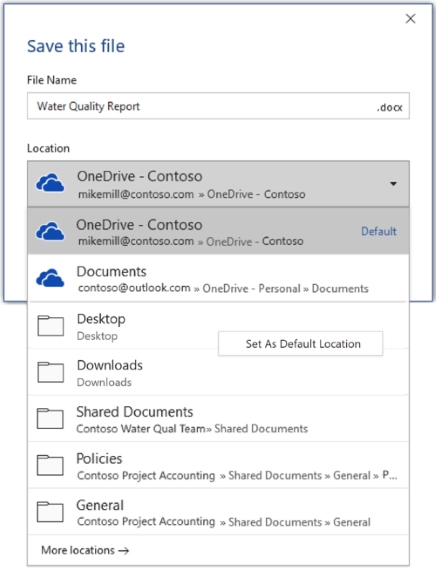
If you want to salve to a location other than your recently-used folders, select More than locations. If y'all haven't received this update however, your Office applications will continue to use the File menu for saving.
Tips:
-
You can also press F12 or select File > Save Every bit to open the File menu.
-
If you're used to using keyboard shortcuts when endmost your document, such as ALT+F4, y'all can apace choose to "Don't Save" the file by using the keyboard accelerator cardinal for that push button (ALT+N).
Save a copy as a new file (Save Equally)
Tip:If you're going to create a new file based on an existing file, just but want your changes saved in the new file, it'southward a adept idea to Save a Copy before you've made whatsoever changes. That way your original file will remain unchanged and all your edits will be in the new re-create. You can too right-click the original file and select Open a copy.
-
Printing F12 or click File > Save a Copy
-
By default Office will save the copy in the same location as the original. If you're happy with the existing location go on to step iii. If yous desire to save the new copy in a different location choose information technology at this point.
Location
Clarification
Sites – [Your Company Name]
SharePoint or Role 365 Groups certificate libraries
OneDrive – [Your Visitor Proper noun]
OneDrive for Business concern
OneDrive – Personal
OneDrive for consumers via your Microsoft account
This PC
Your local device, including whatsoever connected hard drives or flash drives
Browse
Opens the File Explorer so yous can navigate to whatever location on your reckoner.
-
Give your new copy a name and click Save.
Your original file will exist airtight and you'll now be working in the new copy you only created.
Tip:If you find yourself creating new files based on existing files often, you lot may want to utilise templates to make the process easier and safer. See Create a template for more information.
Salve as a different format
You might desire to salvage your file in another format and then that you, or somebody else, can open the file in a different programme or older version. For case, you might desire to save your Give-and-take document as a Rich Text File (RTF) or your Excel workbook as a Comma-Separated Values (CSV) file.
Important:If you save an Office file in a format other than the Open up XML format (such as .DOCX, .XLSX, or .PPTX) some connected experiences and modernistic features similar AutoSave or Accessibility Checker won't work on that file.
-
Click the File tab.
-
Click Salvage As.
-
Cull a file location, such as OneDrive or This PC to store your file.
-
In the File name box, enter a new name for the file.
-
In the Save as type list, click the file format that you want to save the file in. For example, click Rich Text Format (.rtf), Word 97-2003 (.doc), Spider web Page (.htm or .html), or Comma Delimited (.csv).
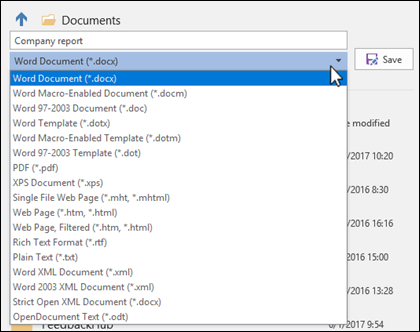
For more information about how to save files in PDF (.pdf) or XPS (.xps) formats, come across Save or convert to PDF or XPS.
-
Click Save.
Support and recover your files
How y'all back up and recover your files depends on where and when you saved information technology. To larn more about a feature, including which versions of Office back up it, select the name of the feature in the table below.
Saved to OneDrive
Saved to your device
If AutoRecover is turned on and your file closes unexpectedly, Document Recovery opens the adjacent time you open the Role app. You can also recover an earlier version of an Office file.
Important:Even if AutoRecover is turned on, you should relieve the file frequently while you're working on information technology to avoid losing data because of an unexpected power failure or other trouble.
Yous tin can save a copy as a new file, or in a different format, or to a different location in Role 2016.
Save a copy as a new file (Save As)
Tip:If you're going to create a new file, based on an existing file, just merely want your changes saved in the new file it'due south a good idea to do the Salve a Copy process first affair; before you've made whatsoever changes. That mode your original file will remain unchanged and all your edits will exist in the new copy.
-
Press F12 or click File > Salve a Copy
-
By default Office will save the copy in the same location as the original. If you desire to save the new re-create in a different location choose it at this betoken. If you're happy with the existing location go on to step three.
-
Requite your new re-create a proper noun and click Save.
Your original file will be closed and you'll now be working in the new re-create you just created.
Tip:If you observe yourself creating new files based on existing files oft, you may want to use templates to brand the process easier and safer. Encounter Create a template for more information.
Cull a different location to salve your file
During the Save, or Save a Copy, process described in a higher place you lot can cull a different location to save your file.
-
Select the cloud, web site, or device location where you want to salve the file.
Location
Description
Sites – [Your Visitor Proper noun]
SharePoint or Office 365 Groups document libraries
OneDrive – [Your Visitor Name]
OneDrive for Business
OneDrive – Personal
OneDrive for consumers via your Microsoft account
This PC
Your local device, including whatever connected hard drives or flash drives
Browse
Opens the File Explorer so y'all tin navigate to any location on your computer.
-
Select a binder from the Recent Folders list, or click Scan if you lot don't encounter the location you want listed there.
-
Ostend the filename you desire to apply and click Save.
Save as a different, or older, format
Yous might want to salvage your file in another format so that you lot, or somebody else, can open up the file in a dissimilar programme or older version. For example, you might want to save your Word 2016 document as a Rich Text File (RTF) or your Excel workbook as a Comma-Separated Values (CSV) file.
-
Click the File tab.
-
Click Salvage As.
-
Choose a file location, such equally OneDrive or This PC to store your file.
-
In the File name box, enter a new name for the file.
-
In the Salvage every bit type list, click the file format that you want to relieve the file in. For example, click Rich Text Format (.rtf), Word 97-2003 (.doc), Web Page (.htm or .html), or Comma Delimited (.csv).
Note:For more data about how to save files in PDF (.pdf) or XPS (.xps) formats, run across Save or convert to PDF or XPS.
-
Click Salvage.
Save equally a copy, or to a different location in Function 2013.
-
Select the cloud, spider web site, or device location where y'all want to save the file.
Location
Description
Sites – [Your Company Name]
SharePoint Server 2013 or earlier certificate libraries
OneDrive – [Your Visitor Name]
OneDrive for work or school
OneDrive – Personal
OneDrive for consumers via your Microsoft account
Other web locations
Any other websites you accept file storage access to.
Computer
Your local device
-
Select a folder from the Recent Folders list, or click Browse if you lot don't see the location you want listed in that location.
-
Confirm the filename you desire to use and click Save.
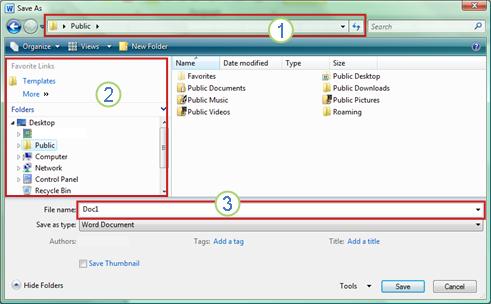
When yous utilise the Salvage As dialog box, you tin also save the file to a new location by using the Navigation pane.
-
To choose a folder or type the path to a folder, use the Address Bar.
-
To quickly see locations you utilize oftentimes, utilize the Navigation pane.
-
To see more than file types, click the pointer.
You can also use the Salve Every bit dialog box to rename a file or change the location of where y'all save the file by clicking a different folder.
Y'all might want to save your file in another format so that you lot, or somebody else, tin open up the file in a unlike program or older version. For instance, you might want to save your Word certificate as a Rich Text File (RTF) or your Excel workbook as a Comma-Separated Values (CSV) file.
-
Click the File tab.
-
Click Salve Every bit.
-
Choose a file location, such as OneDrive or This PC to store your file.
-
In the File name box, enter a new name for the file.
-
In the Relieve as type listing, click the file format that you want to save the file in. For example, click Rich Text Format (.rtf), Spider web Page (.htm or .html), or Comma Delimited (.csv).
Annotation:For more information most how to salve files in PDF (.pdf) or XPS (.xps) formats, see Save or convert to PDF or XPS.
-
Click Save.
If you are using Office 2010, y'all tin can salvage files in an earlier version of Office by selecting the version in the Save equally type list in the Save As dialog box. For instance, you can salvage your Word 2010 document (.docx) every bit a 97-2003 document (.md).
Notes:
-
Office 2010 continues the utilize of the XML-based file formats, such equally .docx, .xlsx, and .pptx, introduced in the 2007 Role release. Therefore, files created in Microsoft Word 2010, Microsoft Excel 2010, and Microsoft PowerPoint 2010 tin can be opened in the 2007 Office release programs without special add-ins or loss of functionality. For more data, see Open XML Formats and file name extensions.
-
For more than information about compatibility between files from unlike releases, meet Use the Compatibility Checker.
For data nigh saving Microsoft Admission 2010 .ACCDB files into the older .MDB format see Convert an .accdb database to an before file format.
-
Click the File tab.
-
Click Relieve As.
-
In the File proper name box, enter a new name for the file.
-
Click Relieve.
When yous apply the Save As dialog box, you tin also salve the file to a new location past using the Navigation pane.
-
To choose a binder or type the path to a folder, utilize the Address Bar.
-
To apace see locations yous use often, use the Navigation pane.
-
To see more file types, click the arrow.
You tin also use the Save As dialog box to rename a file or change the location of where you salve the file by clicking a different folder.
You lot might desire to save your file in another format so that you, or somebody else, can open the file in a different program or older version. For instance, y'all might desire to salvage your Discussion certificate equally a Rich Text File (RTF) or your Excel workbook every bit a Comma-Separated Values (CSV) file.
-
Click the File tab.
-
Click Salve As.
-
Cull a file location, such as OneDrive or This PC to store your file.
-
In the File name box, enter a new name for the file.
-
In the Save as blazon list, click the file format that you lot want to save the file in. For instance, click Rich Text Format (.rtf), Web Folio (.htm or .html), or Comma Delimited (.csv).
Notation:For more information almost how to save files in PDF (.pdf) or XPS (.xps) formats, see Save or catechumen to PDF or XPS.
-
Click Salve.
If yous are using Office 2010, you tin can salve files in an earlier version of Office by selecting the version in the Save equally type list in the Save As dialog box. For example, y'all tin can save your Word 2010 document (.docx) as a 97-2003 certificate (.md).
Notes:
-
Role 2010 continues the apply of the XML-based file formats, such as .docx, .xlsx, and .pptx, introduced in the 2007 Office release. Therefore, files created in Microsoft Word 2010, Microsoft Excel 2010, and Microsoft PowerPoint 2010 can be opened in the 2007 Function release programs without special add together-ins or loss of functionality. For more than information, see Open up XML Formats and file name extensions.
-
For more data about compatibility betwixt files from different releases, run into Use the Compatibility Checker.
For information about saving Microsoft Access 2010 .ACCDB files into the older .MDB format see Convert an .accdb database to an earlier file format.
We're listening
This article was updated January 29, 2020 as a result of your comments. If you found it helpful, and especially if y'all didn't, delight employ the feedback controls beneath to permit u.s. know how we can make information technology better.
See Also
-
What is AutoSave?
-
Rename a file
-
Save or catechumen to PDF
-
Store, share, and sync your files
-
What happens when you sign out of Function
Source: https://support.microsoft.com/en-us/office/save-back-up-and-recover-a-file-in-microsoft-office-a7f0a209-ad22-4212-bb53-6cd8e801a6fb
0 Response to "I Saved Something From the Net and It Automatically Uploaded the Documents"
Enviar um comentário